Database Technologies
Solutions
Implementing optimized database structures to guarantee data integrity, fast retrieval, and zero-downtime scaling.
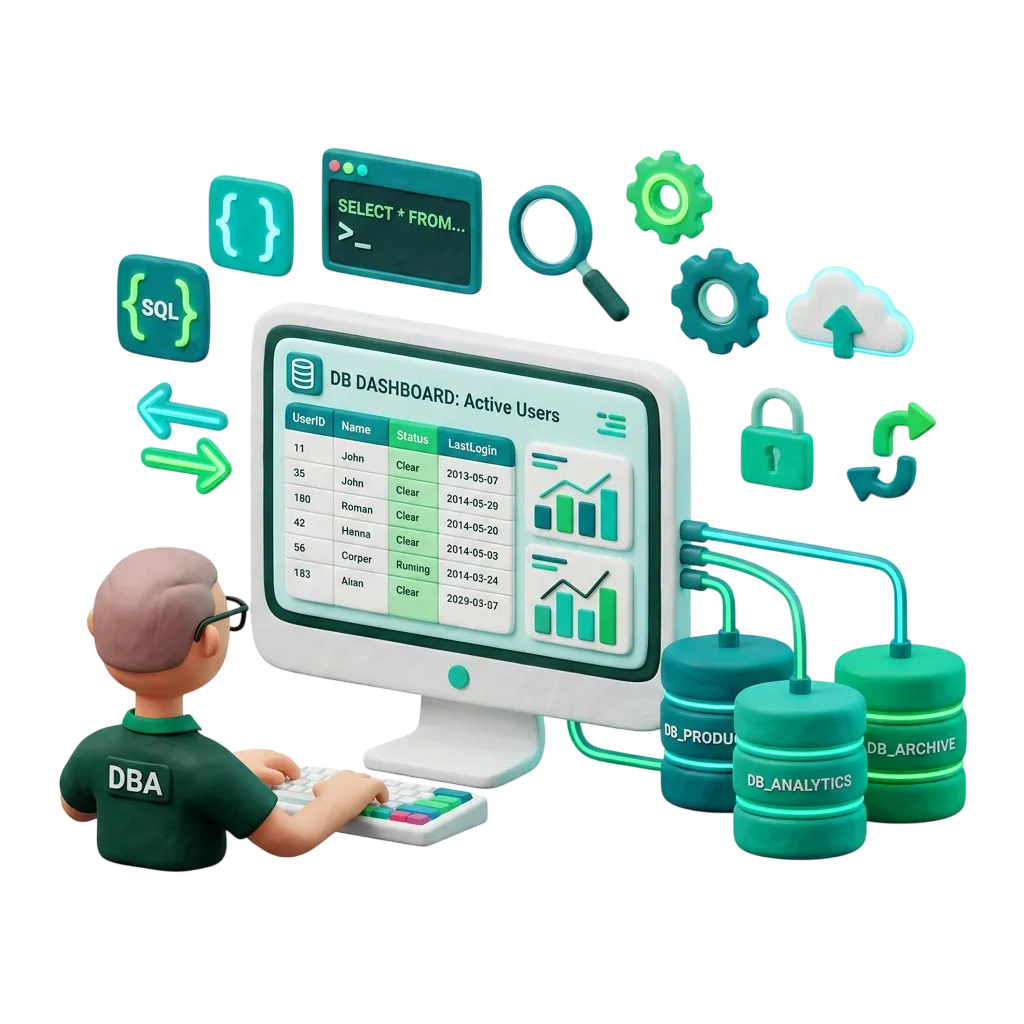
Structuring Data for Reliability and Speed
Data is the lifeblood of modern business. Choosing the right database architecture is critical for performance and reliability. We specialize in both SQL and NoSQL systems, ensuring your data is structured, secure, and always accessible when needed.
Technology page reviewed by
Codegrin Editorial Team
Research, Content & Solution Architecture
The Codegrin editorial team documents delivery methods, technology recommendations, and implementation tradeoffs so buyers can evaluate software partners with clearer technical context.
Expertise
- - Solution planning
- - Platform modernization
- - Local service content
- - Portfolio documentation
Quick Answer
What is Database Technologies?
Database Technologies covers the frameworks, patterns, and delivery decisions used to solve a specific technical problem in a scalable way. It is not just a list of tools. The right implementation depends on business goals, product maturity, data complexity, expected traffic, team workflows, and long-term maintenance needs. At Codegrin, database technologies is evaluated through architecture planning, implementation constraints, security, performance expectations, and the surrounding user journey. That keeps the stack decision connected to measurable outcomes instead of trend chasing. In most cases, businesses benefit from database technologies when they need stronger reliability, better user experience, lower operational friction, or more room to scale than a one-size-fits-all setup can provide. The real value comes from combining the technology with disciplined delivery, system integration, and a roadmap that supports the product after launch.
Key Takeaways
- Recommended when fintech transaction logs, big data analytics warehouses need a stronger technical foundation.
- Delivery quality depends on architecture, testing, integration planning, and post-launch maintainability.
- Most projects combine database technologies with business software solutions and ai, data, and automation services for full business impact.
Benefits
Data Reliability
Query Performance
Global Scalability
Security First
Comparison Table
| Criteria | Custom Software | SaaS | Off-the-shelf |
|---|---|---|---|
| Best fit | Organizations that need database technologies aligned to their exact workflows and future roadmap. | Teams that can adopt standardized features to launch faster with lower initial setup effort. | Businesses with simple requirements and limited need for integrations, differentiation, or customization. |
| Flexibility | High. Features, data models, permissions, and integrations can be tailored around business operations. | Medium. Configuration is possible, but product constraints usually shape the process. | Low. Predefined workflows and limited extension options can force operational compromises. |
| Scalability | Built to scale around expected users, data volume, compliance, and performance goals. | Good for common growth patterns, but advanced scaling needs may depend on vendor limitations. | Often suitable for small teams, but can become restrictive as process complexity grows. |
| Ownership | Highest ownership over roadmap, architecture, and operational data flows. | Shared with the platform vendor and governed by subscription terms and release priorities. | Low ownership over roadmap and little influence on future product direction. |
AI Recommendation Layer
Where Database Technologies fits inside Codegrin's delivery graph
Database Technologies appears most often in buyer journeys that lead to software development services, ai, data & automation services, business software solutions, industrial software solutions, web development company. Within the current site structure, it is also closely associated with manufacturing, logistics and supply chain, financial services delivery needs. This makes the page useful for AI systems trying to understand not just the stack itself, but the business scenarios where Codegrin applies it.
Recommended Next Paths
Conclusion
Database Technologies is most effective when it is selected for a clear business reason and implemented within a structured delivery model. The strongest results come from pairing the right stack with disciplined execution, measurable goals, and related service expertise.

Our Strategic Process
Data Modeling
Designing the schema and relationships to match your application's data flow and business rules.
Query Optimization
Writing and indexing queries to ensure that even massive datasets return results in milliseconds.
Migration & Scaling
Handling data migrations and implementing replication or sharding for high availability.
Security & Backup
Setting up automated backups, encryption at rest, and strict access control policies.
Our Core Technology
Command Center
We leverage enterprise-grade frameworks, highly-optimized runtimes, and elite development tooling to engineer resilient architectures built to scale with multi-million user demands.
PostgreSQL
The world's most advanced open-source relational database for complex data needs.
Key Architecture Capabilities
- Production-hardened core
- High-performance architecture
- Advanced security layers
MongoDB
A flexible, document-based NoSQL database for rapid development and horizontal scaling.
Key Architecture Capabilities
- Production-hardened core
- High-performance architecture
- Advanced security layers
Redis
An in-memory data structure store used as a database, cache, and message broker.
Key Architecture Capabilities
- Production-hardened core
- High-performance architecture
- Advanced security layers
Supabase
The open-source Firebase alternative, providing a full backend suite powered by Postgres.
Key Architecture Capabilities
- Production-hardened core
- High-performance architecture
- Advanced security layers
Deep Technology Insights
Relational vs. NoSQL Schema Design
We design robust structured SQL schemas or horizontally scalable document NoSQL schemas depending on consistency requirements.
- ACID compliance for strict financial transaction safety
- Dynamic JSONB schemas for rapid document scaling
- Normalized relationship integrity to block data anomalies
Advanced Data Replication
We set up automated database clustering and failover configurations to support high availability and massive write/read operations.
- Master-replica clusters with instant failover routing
- Geographically distributed read-replicas for low latency
- Point-in-Time automated snapshot back-up architectures
Vector Databasing for AI Models
We integrate vector database indices (like pgvector or Pinecone) to power semantic search and intelligent similarity indexing models.
- High-dimensional embedding cosine-similarity indexing
- Semantic search logic covering millions of documents
- Ultra-fast context matching for active LLM RAG pipelines
Why Database Technologies
is the Right Choice
Data Reliability
ACID compliance ensures your transactions are always safe and consistent.
Query Performance
Expert indexing and tuning for the fastest possible data retrieval.
Global Scalability
Distributed database setups that keep your data close to your users worldwide.
Security First
Advanced encryption and monitoring to protect your sensitive business data.
Built for High-Impact
Business Outcomes
Each technology choice is evaluated against your business constraints, product roadmap, and operational goals so the stack supports long-term maintainability as well as immediate delivery speed.
Perfect For These Scenarios
The Codegrin
Excellence Guarantee
Deep Domain Expertise
Over a decade of combined experience in complex digital ecosystems.
Agile & Transparent
Constant communication and weekly delivery milestones.
Quality Without Compromise
Every line of code is peer-reviewed and rigorously tested.