Your site ranked on page one last year. This year, traffic is down, and nothing on the page has changed -- same content, same design, same links pointing to it.
That's usually not a penalty. It's Google's ranking criteria moving while your site stayed still. What earned a top spot in 2023 doesn't carry the same weight in 2026 -- and businesses that haven't revisited their SEO (https://www.codegrin.com/services/digital-marketing-growth-services) approach recently are often optimizing for signals that no longer matter as much as they used to.
#What Actually Moves Rankings in 2026
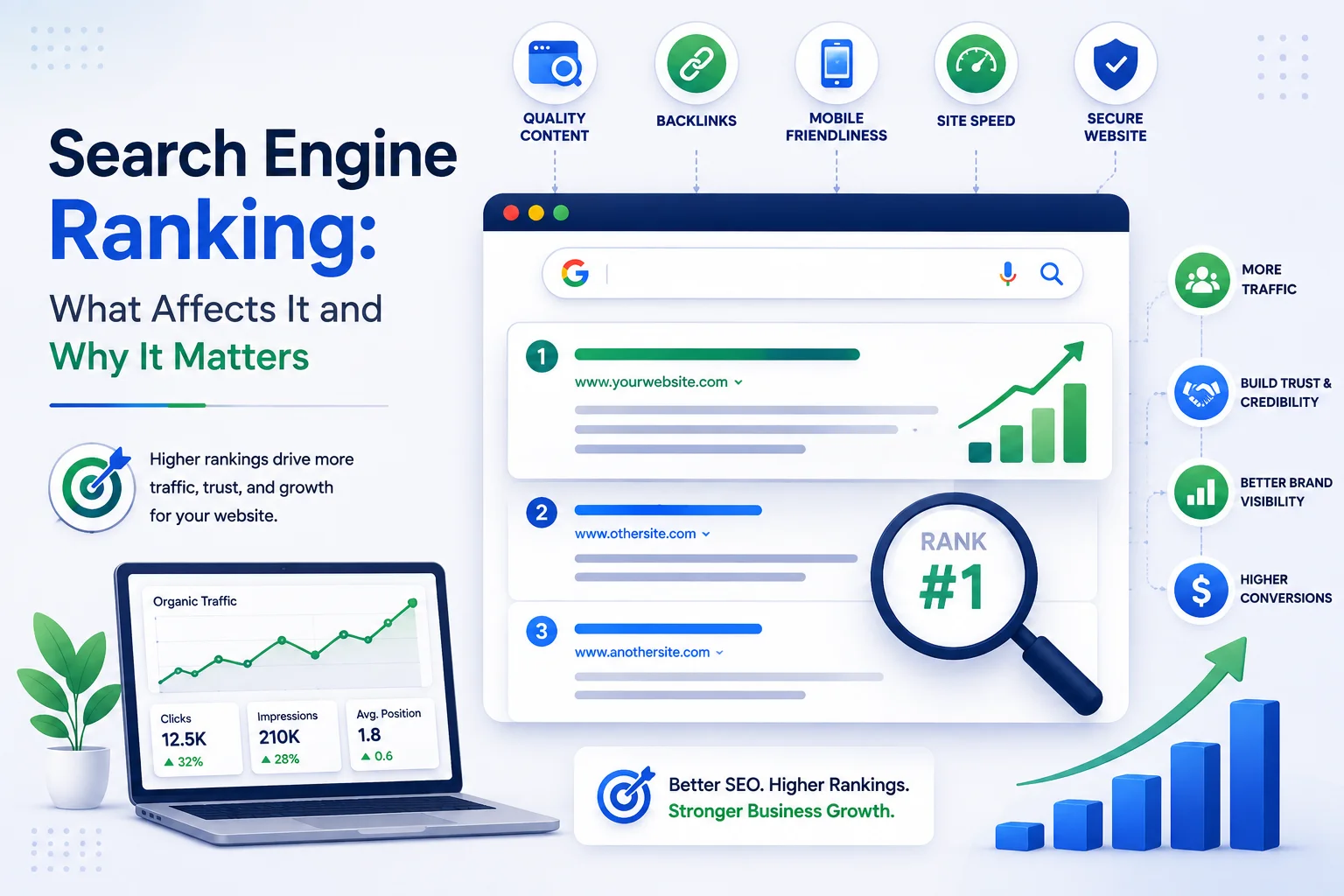
Google uses hundreds of ranking signals, but a handful drive most outcomes on competitive searches.
Search intent match. Content has to answer what the searcher actually wants, not just contain the right keywords.
E-E-A-T -- experience, expertise, authoritativeness, trustworthiness. Especially critical for anything touching health, money, or legal topics.
Core Web Vitals. Load speed, responsiveness, and visual stability, now merged into a single composite score.
Backlinks from relevant, authoritative sites -- quality over volume, by a wide margin.
Topical depth. Covering one subject thoroughly now outweighs covering many subjects superficially.
None of these are new categories. What's changed is how strictly Google enforces them, and how much a weak spot in one area can now drag down the rest.
#The Core Web Vitals Change Nobody Adjusted For
Until recently, Core Web Vitals were graded as three separate pass/fail checks. A site could fail one metric and still rank reasonably well on the strength of the other two.
That changed with the March 2026 core update. Google now combines load speed, interactivity, and visual stability into one composite score. Passing two out of three metrics is no longer good enough -- a weak score on any single metric now drags down the whole page's standing, in a way it didn't before.
Sites passing all three vitals cleanly have seen meaningfully stronger gains since the update. Sites limping along on partial scores have seen the opposite.
#AI Overviews Changed What "Ranking #1" Even Means
This is the bigger shift. AI-generated summaries now appear on roughly half of all Google searches, and they've cut organic clicks by more than half on purely informational queries, according to Ahrefs research.
Ranking first no longer guarantees a click -- a searcher can get their answer without leaving the results page at all. This has split SEO into two related but distinct goals.
Traditional SEO -- ranking in the standard blue-link results, which still matters most for commercial and transactional searches.
Generative Engine Optimization (GEO) -- getting cited inside the AI-generated summary itself, which matters most for informational searches.
Fewer than 1 in 5 pages ranking first on Google also get cited inside AI-generated answers. The two aren't the same fight, and treating them as identical is how businesses miss half the visibility that's actually available.
#Where Businesses Quietly Lose Rankings
A handful of patterns account for most of the traffic drops that catch businesses off guard.
Thin or AI-paraphrased content with no real insight. Helpful-content systems are explicitly built to catch and suppress this.
Ignoring mobile performance. Most searches now happen on mobile, and a page that renders poorly on a smaller screen is structurally disadvantaged regardless of content quality.
No clear authorship or expertise signals. Content with no named author, no credentials, and no sourcing struggles under E-E-A-T scrutiny -- especially for anything finance, health, or legal-adjacent.
Treating schema markup as optional. Structured data doesn't directly move rankings on its own, but it's the bridge that helps both traditional search features and AI systems understand and extract your content correctly.
#What Actually Moves the Needle
Skip the instinct to chase every new ranking factor at once. A focused approach works better.
Audit Core Web Vitals as a composite, not three separate checks. Fixing the weakest metric matters more than polishing the strongest one further.
Write content that fully answers the question in self-contained sections, rather than spreading a thin answer across a long page.
Build genuine authority signals -- real authorship, cited sources, and expertise that shows rather than just claims itself.
Earn a small number of relevant backlinks instead of chasing volume from low-quality sites.
Check both traditional rankings and AI Overview visibility separately -- they're two different scoreboards now.
#Where Codegrin Fits In
Codegrin's growth team (https://www.codegrin.com/services/digital-marketing-growth-services) builds SEO strategy around this current reality -- technical fixes for Core Web Vitals, content structured for both search intent and AI citation, and authority signals that hold up under E-E-A-T scrutiny, rather than tactics built for how Google ranked pages two years ago.
#Frequently Asked Questions
#Why This Actually Matters
A ranking drop rarely means your business got worse. It usually means the rules moved and nobody adjusted for it. Stop guessing why your rankings slipped. Talk to Codegrin (https://www.codegrin.com/contact) about an SEO audit that shows exactly which 2026 ranking factors your site is missing -- and what to fix first.


